iPod marked 25th anniversary this week
A quarter-century ago, Apple introduced a compact hard drive device that promised to hold a user's entire music collection in a pocket-sized package.
By Xiaoyu Wang ·
Twenty-five years have passed since a specific moment in October 2001 reshaped how consumers interacted with personal audio.
Steve Jobs, then the chief executive of Apple, unveiled the first-generation iPod at a press event where he initially teased a breakthrough digital device that was not a Mac. The launch price was set at $399, and the core marketing message emphasized the ability to store a user's entire music library in a pocketable form factor. This release occurred during a period of significant corporate recovery for the Cupertino-based company, following the dot-com bubble burst. At the time, Apple had successfully transitioned into the Mac OS X era with well-established iMacs and iBooks, positioning the Mac as the central hub for a user's digital lifestyle, including cameras and DVD players. Jobs argued that while competitors like Sony and Creative already offered portable players, none had found the correct recipe for digital music. He identified hard-disk-based jukebox players as the optimal entry point into a market that lacked a clear leader.
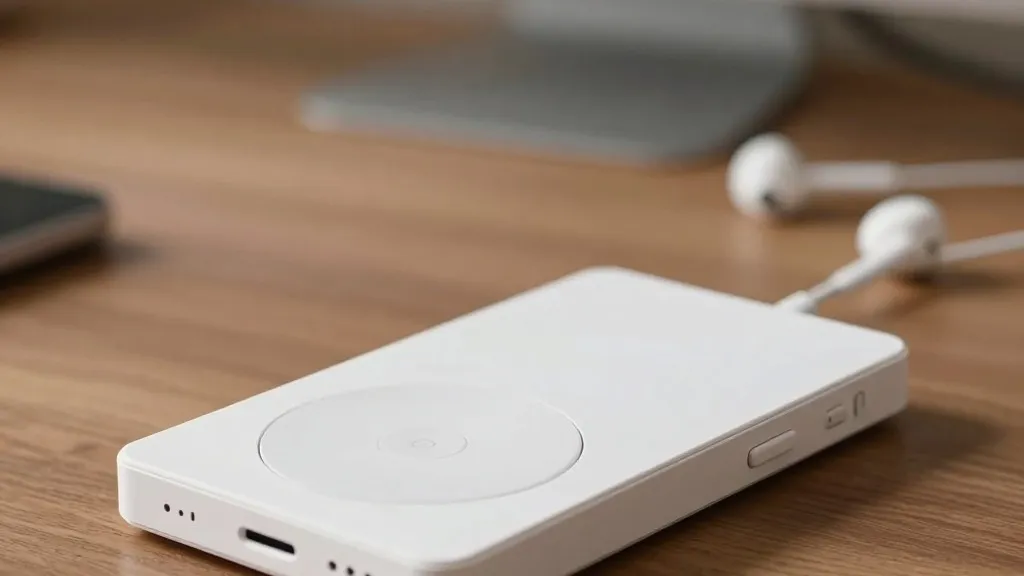
The device featured 5GB of storage capacity, which allowed it to hold 1,000 songs, specifically defined as typical pop tracks in MP3 format at 160Kbps. The physical design was a major selling point, utilizing a Toshiba 1.8-inch hard drive that was 0.2 inches thick. This component enabled the iPod to measure 2.4 by 4 by 0.78 inches, roughly the size of a deck of cards, and weigh just 6.5 ounces, which was lighter than most cell phones of that era. Despite its small footprint, the player included advanced functionality such as 20-minute skip protection and a single FireWire 400 cable for both charging and data transfer. During the presentation, Jobs highlighted the speed of this connection, claiming an entire CD of music could be transferred in five to 10 seconds, a stark contrast to the five minutes required for a USB connection to move the same data.
The user interface was designed for single-hand operation, featuring a scroll wheel with a piezoelectric clicker for tactile feedback that allowed for fast navigation by artist, playlist, or song. The device also included a rechargeable lithium-polymer battery that provided 10 hours of continuous playback, with Apple stating it could reach 80 percent charge in one hour. Simultaneously with the hardware launch, Apple released iTunes 2, which introduced features like MP3 CD burning and Auto-Sync. This feature ensured that any music library curated on a Mac would automatically update on the iPod whenever the device was connected, effectively making the portable player an extension of the desktop computer. The first track demoed on stage was 'Building a Mystery' by Sarah McLachlan.
The impact of this product on the technology landscape was profound, though its dominance was eventually superseded by the smartphone. The first iPhone arrived in early 2007, more than five years after the original iPod's debut. For over a decade, both devices coexisted within Apple's product lineup. However, the iPod line gradually faded from prominence, with the final model, the seventh-generation iPod Touch, released in May 2019. Although the product line was left without updates for several years, Apple officially discontinued it in May 2022, closing a chapter that had defined portable media consumption for a generation.
Source: Tom's Hardware